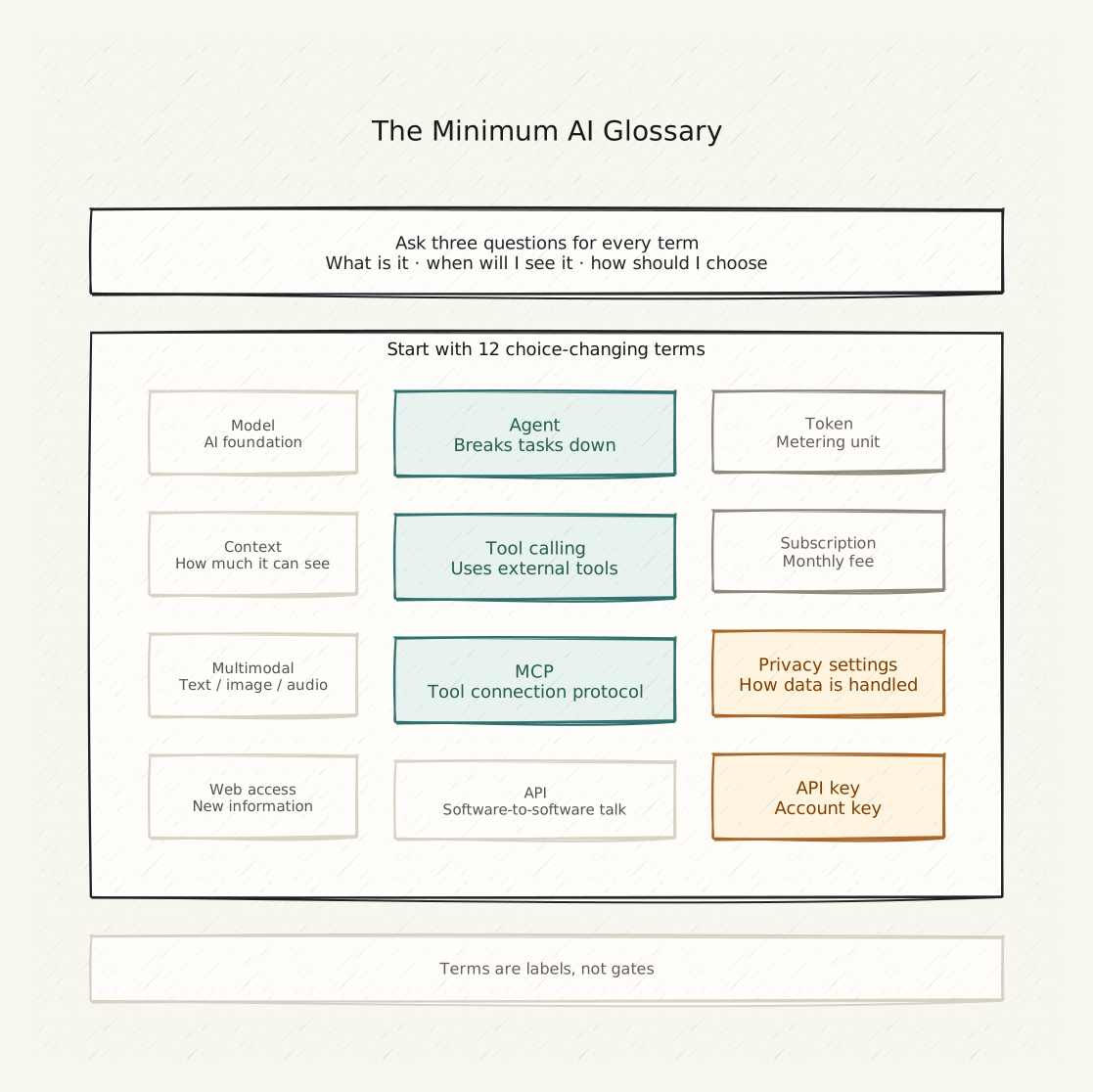
One Clear Statement
Terms are not barriers — they are labels. If you know what they mean, you will not be intimidated the next time you see one.
How to Use This Page
If you encounter a term you do not understand, look it up here first. If it is not here, check the full glossary at the end of this series.
Each term is explained in three lines:
- A plain-language explanation
- A scenario you will actually encounter
- A choice suggestion or caution
Model
Plain language: AI can answer questions because it has read a massive amount of text and learned language patterns. This “learned thing” is called a model.
Scenario: You ask ChatGPT a question and it answers — because it runs on a trained model behind the scenes.
Suggestion: Different companies’ models have different strengths, but ordinary people do not need to compare models. You only need to know which tool can help you get something done.
Token
Plain language: A token is the smallest unit AI uses to process text — roughly one Chinese character or a few English letters. AI charges by the number of tokens consumed.
Scenario: You send a 1000-character article to AI — it converts this into roughly 1300 tokens to process.
Suggestion: Most tools have a daily free token allowance. Normal chat is unlikely to exceed it, but for tasks involving long documents, ask Codex to estimate usage for you.
Context Window
Plain language: How much text AI can “see” at once when answering. The upper limit is called the context window.
Scenario: You send AI a 50-page document and it says “exceeds limit” — the document is too long for its context window.
Suggestion: For tasks involving very long documents, first ask Codex: “What is the maximum input length this tool supports?”
Multimodal
Plain language: The ability to handle one or more of text, images, audio, or video simultaneously.
Scenario: You send an image to AI and it describes what is in it — that is multimodal capability.
Suggestion: Text capabilities among major AI tools are similar. Image understanding, video analysis, and voice processing are key dimensions for comparing tools.
Web Search /联网
Plain language: AI can go online to find current information, not just answer from its training data.
Scenario: You ask “What is today’s news?” — an AI with web search gives you real-time results. One without can only give you information up to its training cutoff date.
Suggestion: For news, price comparisons, or checking whether a website still exists — you need web search. Ask Codex whether the tool you are using supports it.
Agent
Plain language: AI that can automatically perform a sequence of tasks without you directing it step by step.
Scenario: You say “Help me polish this draft and post it to my website” — an agent-type AI will break this down on its own: edit → format → log into website → publish.
Suggestion: Agents are powerful but also more prone to errors. Having it stop to confirm at each step is safer than letting it do everything in one go.
Tool Use / Function Calling
Plain language: AI that can call other tools — calculators, weather services, email, file readers.
Scenario: You ask “Calculate my total income from January 2024 until now” — AI calls the calculator tool to process the numbers.
Suggestion: Tool calling is one of Codex’s core capabilities. It can read files, edit files, open browsers, run checks — all through tool calling.
API
Plain language: An interface for passing instructions between two software programs. Ordinary people do not need to write APIs, but sometimes they need to provide an API Key to authorize AI.
Scenario: In Codex, it sometimes asks you to provide an API Key — this is how it gets authorized to act on your behalf.
Suggestion: An API Key is like an account password. Do not share it with others, and do not commit it to public code repositories.
Subscription vs. Pay-as-You-Go
Plain language: A subscription is a fixed monthly fee with unlimited usage (or a cap); pay-as-you-go charges by actual usage.
Scenario: ChatGPT Plus is a subscription (fixed monthly), OpenAI API is pay-as-you-go (pay for what you use).
Suggestion: For ordinary daily use, a subscription is simpler. For developers or heavy users, pay-as-you-go is more cost-efficient. Test your needs with the free version first, then decide.
Hallucination
Plain language: AI can “fabricate” content that sounds completely true — it is not being dishonest. Its training method makes it fill in what it thinks you want to hear.
Scenario: You ask “Who invented quantum entanglement?” and AI gives you a name and year — but this field has no single clear “inventor.” It made up a plausible-sounding answer.
Suggestion: For important facts — names, dates, legal clauses, technical specs — ask Codex for source links, or verify the information yourself before using it in a formal context.
Privacy and Data
Plain language: Whether the content you send to AI will be used for training or reviewed by humans — different tools have different policies.
Scenario: You send a document with internal company information to AI to ask questions about it — you want to confirm this document will not be used for training.
Suggestion: Content sent to AI is effectively public. For any important files, ID numbers, bank card numbers, or internal data, check the privacy policy first before sending. If you are not sure, ask Codex to look up the official privacy page for you.
How to Know You Are Done
You do not need to memorize every definition.
After reading this page, you only need to do one thing:
When you encounter an unfamiliar AI term, look it up here first. If it is not here, check the glossary. Knowing what a term means means it will not intimidate you the next time.
Next: Foreign Models, Accounts, Networks, and Real-World Limits — learn which tools you can actually use.
Public social links